A useful storage setup gives a leather bag three things: support, protection from dust, and a suitable environment. A beautiful display box does not automatically provide all three. Start with the bag's own care instructions, then choose a place where you can put it away without squeezing it into shape or forgetting about its condition.
This guide is for everyday handbags that are dry and in sound condition. Antique, brittle, heavily decorated or already damaged bags may need individual advice before packing.
Start with the material, not a shopping list
Find the care card, original product description or maker's material information. A pebbled surface does not by itself tell you which cleaner or conditioner is suitable. A bag can also combine several materials: the exterior, lining, edge coating and strap may have different care needs.
Leatherology's leather-care guide gives different instructions for its standard, suede, Berlin and Italian Unlined leathers. It specifically excludes cleaner and conditioner from the routine for some of those materials. That is a useful reminder to check the actual item before treating it. One maker's product recommendations are not approval for a different brand's bag.
Our leather-type reference can help you describe what you see. For a fuzzy surface, consult the suede and nubuck guide before trying smooth-leather care products. If the finish remains uncertain, ask the maker a specific question: "What should touch this exterior and lining during storage?"
Empty and assess before packing
Remove the contents and check each pocket. Look over the base, corners, handles and lining while the bag is easy to inspect. Photograph any existing mark for your own reference; that gives you a starting point if something changes later.
Leatherology's handbag-storage guide recommends removing contents, preparing the surface and allowing a cleaned bag to dry before putting it away. Use only a preparation method approved for your material. Storage is not a reason to introduce an unfamiliar treatment.
Support the shape without stretching it
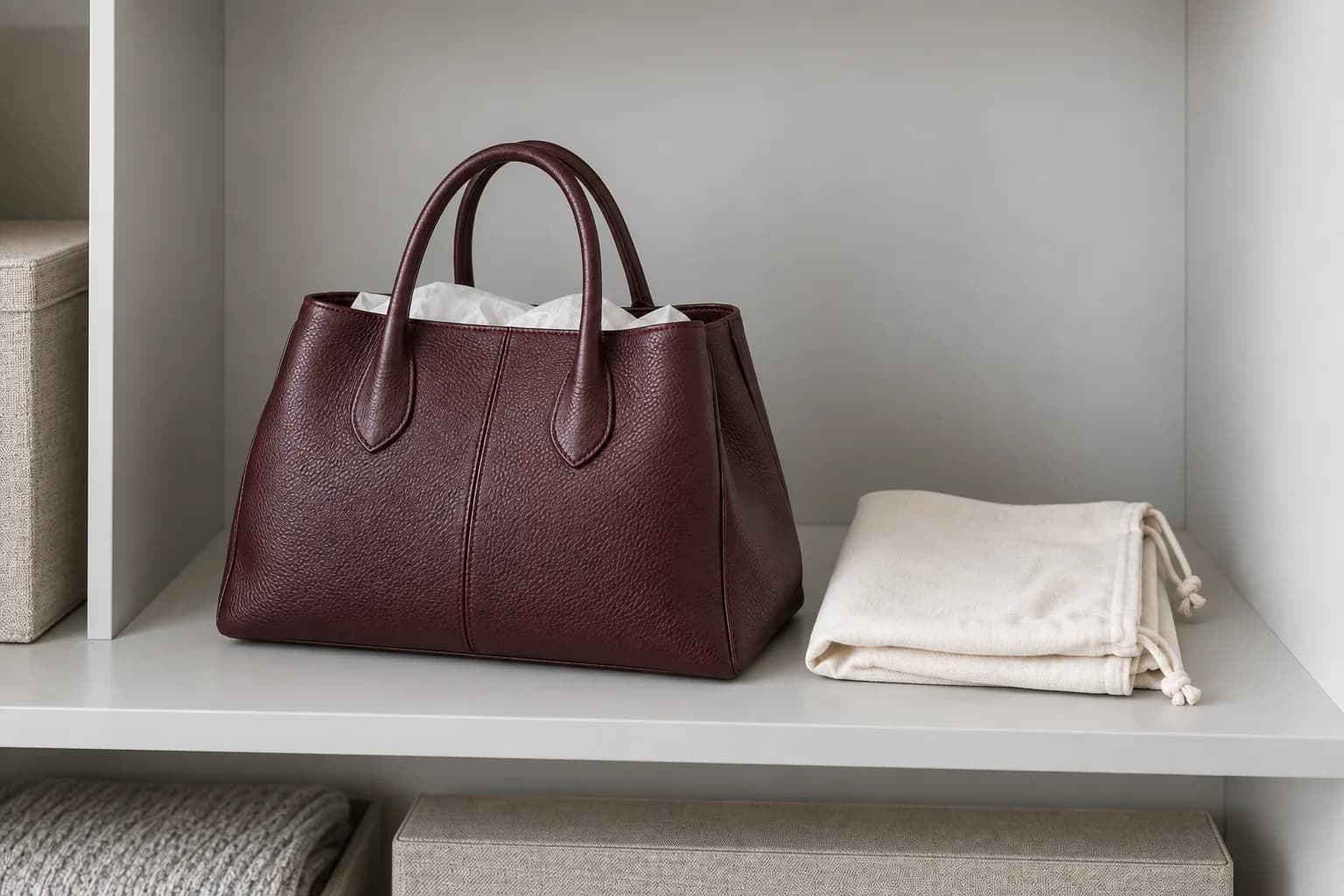
Use a modest amount of suitable soft packing to support the bag's resting shape. Add it gradually. Stop if the sides bulge, the opening becomes difficult to close or a seam is pulled taut. A naturally soft bag does not need to become rigid.
The Canadian Conservation Institute's leather-care guidance recommends internal support for three-dimensional leather objects while warning that excessive filling can stretch material or stress stitching. Its advice concerns collections, so a fragile historic bag needs a conservator's assessment, not an attempt to force an old crease out at home.
For an ordinary structured handbag, a supported position on a shelf is a practical starting point. Leatherology distinguishes this from long-term hanging by thin straps. Give nearby bags their own space instead of using one to prop up or compress another.
Choose a cover and location together
A breathable dust cover is useful, but the surrounding cupboard still matters. Leatherology recommends cloth covers or cotton pillowcases for leather bags and cautions against plastic enclosures that trap moisture. The cover should fit easily around the supported bag.
Leatherology's care page also warns against leaving objects on top of leather or letting it fold unnecessarily, and recommends keeping stored pieces out of direct sunlight. A shelf crowded with heavy objects is therefore a poor choice even if the bag has its original cover. Moving a few neighbouring items may be more useful than buying another organiser.
The Canadian Conservation Institute also recommends avoiding damp conditions and major humidity swings. In a humid home, a dust bag does not correct a damp wardrobe. Choose a more stable location and investigate recurring dampness rather than assuming extra wrapping solves the problem. This is an environmental precaution, not a treatment for suspected mould.
Leave yourself a simple inspection routine
Keep a short note of the storage date, the material information you found and any mark worth watching. Check the bag when changing your regular rotation and after a known storage problem, such as a leak. There is no universal inspection interval that suits every climate, cupboard and finish.
Compare its condition with your earlier note before adding products or adjusting the packing. If you discover tackiness, colour transfer, an unexplained odour, a new distortion or suspected mould, stop treating it as a routine storage question. Describe the change to the manufacturer or a qualified repairer. Do not try to hide it with fragrance or an unverified cleaning mixture.
The goal is a repeatable setup you can inspect: the right support, enough space, an appropriate cover and a location suited to the item. None of these measures promises to remove existing damage or keep every leather unchanged indefinitely.
AI-assisted article researched and prepared with Codex. No hands-on test is claimed. Read our editorial standards.